
Posted on Semiconductor Digest Click here to view original article
By: David Lammers
Snowbird, Utah – The interactions between OSAT suppliers, chiplet vendors, and foundries are becoming “much more intimate as we move forward,” and moving to AI-based information flows will intensify the trend, speakers at the Advanced Process Control Smart Manufacturing (APCSM) conference said here.
John Kibarian, CEO of PDF Solutions, kicked off the 2025 APCSM conference with a keynote address that looked at the challenges of real-time data sharing across the value chain. The winning companies, he said, are re-thinking how they collaborate as the supply chain becomes more complex. PDF Solutions, through its acquisition of SecureWise and its own nearly ubiquitous presence among the global IC manufacturers, is in a unique position to see how fast the industry is changing, he said.
“Over the years, we have seen how the large companies have moved beyond a crisis-driven response that involved interactions between humans, linear in the flow, involving a small amount of data, where the human was at the center of that collaboration.” Things really started to change at the 7-nanometer node. The higher number of process steps required foundries to work more closely with their equipment suppliers. That caused the amount of data to flow back and forth to explode. “We think that is happening now with the assembly flows” during advanced packaging. One consequence is that leading edge-foundries are taking back some of the wafer sort testing that used to be in the hands of the OSATs.
“What we are seeing now is tremendous progress in advanced packaging which brings together the foundries and OSATs in a much more intimate relationship,” Kibarian said.
Chiplets are another force for change. Designing a large SoC can take upwards of two years, leading more companies to integrate smaller chiplets with higher yields and shorter time to market.
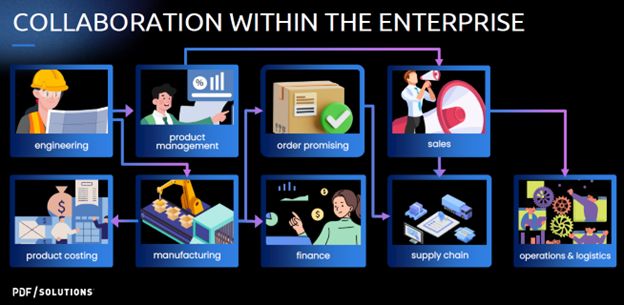
Kibarian described two types of collaboration, one among companies in the supply chain, and another within an organization. Internally, creating a “constrained data set” so the finance and management personnel can benefit is one challenge. “How do you create a simple view of a complex environment for another part of the organization? What is the BOM cost? How much time does a wafer spend on any given tool? With a few thousand steps in the process flow, how can the ERP come up with a cost estimate?”
Management needs “constrained” data set. (Source: John Kibarian presentation at APCSM)
Another ongoing challenge is to make better use of available data.
Kibarian estimated that 80 percent of a data scientist’s time is spent on data alignment and preparation. Also, only about 5 to 10 percent of the available manufacturing data is being analyzed, most often using traditional methods. Companies need to “deploy AI close to the data, to make use of all the data to drive insights and actions,” he said.
In a world where governments are pressuring companies to use domestic suppliers, that can mean creating one supply chain for Europe, another for the United States, a third for Asia, and so on. And data security remains an imperative. Nevertheless, Kibarian said companies have the opportunity to “connect the entire supply chain using the existing global data exchange network infrastructure” to “look across large, wide data sets.”
The goal is to create a multi-party “orchestration” where data analysis is automated by machine learning and other tools.
Digital twins reduce prototype cost
S.J. Wang, a product manager at the Applied Materials Automation Products Group, described Applied’s work with digital twins (DTs) for equipment and product health monitoring.
A digital twin requires three components: a model that shows the relationship between inputs and outputs; a digital representation of an asset; and third, a need to predict something that will provide for optimization.
A good digital twin will support decision making and better predict the best manufacturing path. A third benefit is economic: instead of taking three months or so to build a chip prototype, a digital twin based on a physics model of a tool can help simulate a process. “We can simulate a process at feature scale, and simulate the physics from the initial to the final state. Also, we can look at the mechanicals, and predict electricity consumption,” Wang said.
ML pilot project recommended
Alan Weber, vice president of new product innovations at PDF Solutions, described the challenges in creating an AI-based tool for anomaly detection. “Turning available data into a machine learning pipeline requires significant effort. Manufacturing data is high-dimensional, multi-rate, and noisy. It is often collected from disparate sources at different sampling rates and latencies,” for example data describing torque, vibration, position, flow rate, temperature, pressure, and spectral distribution.
“Data ‘wrangling’ — aligning, cleaning, normalizing, and extracting features — requires expertise in equipment, signal processing, and software. Data preparation requires interpolation, noise reduction filtering, and transformation to generate useful features,” Weber said.
Selecting a suitable machine learning model “requires AI expertise and experimentation,” followed by embedding it in a live system, monitoring for drift, and updating periodically. All of this “requires significant collaboration across teams, including data scientists, IT, and automation engineers,” Weber said.
The benefits can be “ideal for predictive maintenance and early fault detection in high-uptime environments.”
“The best way to learn about AI/ML opportunities in manufacturing is to identify a well-scoped problem worth solving and launch a pilot project,” Weber said.
MCP framework provides standard
Jim Redman, president of AI tool vendor ErgoTech (Los Alamos, N.M), said manufacturing companies which fail to implement AI-based solutions will find it difficult to survive.
Tools such as ErgoTech’s MIStudio minimize the amount of coding required. “Fault detection and classification finds the faults while AI makes them actionable. AI adds context, causes, evidence and actions. It connects the dots across signals, history, and notes to form a clear story.”
AI tools find the likely root causes and ranks them, Redman said, thereby reducing trial-and-error. It suggests safe next steps (checks or actions) for human confirmation, and cuts triage time while improving consistency and auditability.
Redman gave a strong recommendation that the semiconductor manufacturing industry implement the Model Context Protocol (MCP), introduced by Anthropic in November 2024. MCP is a framework designed to standardize how AI systems integrate and share data with external tools and systems. MCP aims to address the challenges posed by information silos and legacy systems, which hinder the effective use of AI in various applications, he said.
“MCP serves as a universal interface, providing a standardized way for AI applications to connect with various data sources, tools, and workflows,” similar to how USB-C ports standardize connections for electronic devices, Redman said. The MCP protocol supports bidirectional connections: secure, two-way communication between AI systems and data sources, enabling AI to access and utilize relevant information effectively.
“As an open-source protocol, MCP encourages collaboration and innovation, allowing developers to create custom implementations that suit their specific needs,” Redman said.