
Posted on SemiWiki.com Click here to view original article
By: Kalar Rajendiran
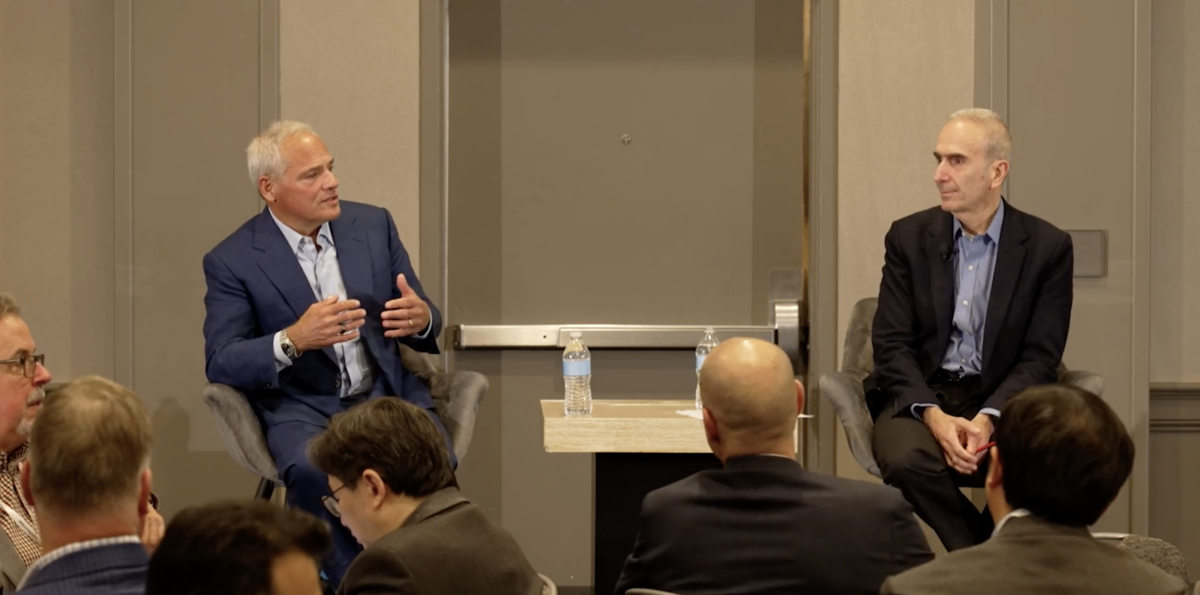
This article is an editorial synthesis of a fireside chat between Tom Caulfield, Executive Chairman of GlobalFoundries, and John Kibarian, CEO of PDF Solutions that took place on December 3rd 2025, during the PDF Solutions Users Conference. John Kibarian led the conversation to get Tom Caulfield’s perspectives on leadership lessons forged at the center of semiconductor manufacturing, strategy, and technological change. Topics ranged from factory operations and AI to supply chains, education, and careers.
As you read, a clear throughline emerges: deliberate leadership choices shape outcomes. Manufacturing is strategy. AI is leverage rather than magic. Accountability defines culture. Sustained success requires leaders willing to embrace discomfort rather than defer it.
The Decision Most Leaders Avoid
When Tom became CEO of GlobalFoundries in 2018, the board expected continued investment in 7nm technology and stable execution across the company’s global footprint, including China. The economics, however, left little room for interpretation. Advanced semiconductor manufacturing had become a scale business dominated by a small number of players investing tens of billions of dollars per node. With approximately $5 billion in annual revenue, GlobalFoundries could not compete in that race without putting the company’s future at risk.
Within weeks, Tom made the decision to exit 7nm. The move was controversial, but it immediately clarified priorities. Rather than chasing prestige, the company chose focus, realism, and a path toward sustainable differentiation.
Manufacturing Is Strategy
Tom’s views on manufacturing were shaped long before GlobalFoundries, during his tenure at IBM. Semiconductor fabs are unforgiving systems where physics enforces discipline. Minor deviations in process control compound quickly into yield loss, missed commitments, and customer dissatisfaction.
What separated high-performing fabs from struggling ones was not simply superior equipment. It was rigor. Engineers were often buried in manual data collection, leaving too little time for analysis or root-cause identification. Accountability was fragmented, and problems persisted longer than they should have.
Improvement required disciplined analytics, automation, and unmistakable ownership. Leaders were expected to absorb pressure rather than transmit it downward, allowing teams to focus on execution instead of self-protection. Manufacturing excellence, Tom learned, is not an aspiration but rather a leadership decision.
Accountability as a Force Multiplier
One of the most counterintuitive insights from the fireside chat was how accountability reduces fear. When responsibility is explicit and leaders are visibly accountable, organizations move faster. Defensive behavior recedes, and problem-solving accelerates.
At GlobalFoundries, ambiguity was unacceptable. The operating rhythm centered on defining the problem and fixing it with urgency.
This mindset extended to careers as well. Tom emphasized that mastery often creates its own trap. When people become highly competent, learning slows, comfort sets in, and growth plateaus. Organizations stagnate for the same reason individuals do. Sustained progress requires leaders and teams to continually place themselves in unfamiliar territory.
Why GlobalFoundries Walked Away from the Leading Edge
Exiting 7nm was not a retreat from relevance. It was an acknowledgment of where demand actually resides. The majority of semiconductor volume serves markets such as automotive, industrial systems, RF, and power management. Segments that value reliability, longevity, and integration over transistor density.
GlobalFoundries’ Singapore operations illustrated what disciplined execution could deliver. Years of sustained reinvestment, operational control, and focus on differentiated technologies produced a profitable and resilient manufacturing base. The strategic mandate became clear: replicate that model across the organization.
By aligning ambition with economic reality, GlobalFoundries positioned itself to compete where it could win rather than where scale dictated the terms.
Global Doesn’t Mean Everywhere; It Means Repeatable
For decades, global manufacturing was equated with geographic reach. In practice, excessive dispersion often created fragility rather than resilience. The fireside chat reframed global manufacturing as repeatability rather than footprint.
True global capability comes from a common manufacturing platform that can be qualified, transferred, and scaled across multiple fabs. Customers care less about the specific location of production than about confidence that supply can shift reliably when disruptions occur.
Repeatability is what converts manufacturing from an operational necessity into a strategic asset.
AI in the Real World: Leverage, Not Magic
Artificial intelligence featured prominently in the discussion, but without exaggeration. AI has demonstrated real value in digital domains such as design verification, predictive maintenance, forecasting, and equipment utilization. In these areas, pattern recognition and optimization deliver measurable returns.
Manufacturing, however, remains grounded in physical reality. Materials, mechanics, and human judgment still govern outcomes. AI can enhance decision-making, but it does not replace accountability or operational discipline.
Leaders who succeed with AI deploy it selectively, prioritizing applications that deliver meaningful, order-of-magnitude improvements rather than incremental gains.
The Semiconductor Supply Chain Is a Leadership Failure
The concentration of advanced semiconductor manufacturing in a single region of the world represents a systemic vulnerability. This is not an ideological concern. It is a failure of governance and risk-management.
While initiatives such as the CHIPS Act have begun addressing supply-side economics, demand-side commitments remain insufficient. Building fabs requires long-term certainty. Manufacturing transitions unfold over years, not quarters, and leadership must plan accordingly.
Supply chain resilience ultimately reflects foresight and responsibility, not nationalism.
AI Is Rewriting Who Captures Value
AI is not only changing how chips are built; it is reshaping industry economics. As design costs fall and software increasingly defines system functionality, system companies are finding it more attractive to develop custom silicon tailored to their products.
This shift places pressure on traditional boundaries between system companies, fabless designers, and foundries. In the next phase of the industry, differentiation and focus will matter more than scale alone.
Leadership Must Institutionalize Global Talent
Modern semiconductor manufacturing and design depend on global talent. Remote engineering, once viewed as a compromise, has become a competitive advantage. Distributed teams enable continuous progress across time zones, broaden perspectives, and expand access to scarce expertise.
The pandemic accelerated adoption, but the deeper lesson endures. Organizations should not wait for crises to modernize how they work. Leadership must institutionalize what works rather than revert to familiar constraints.
Why Liberal Arts Still Matter in an AI World
The discussion concluded with a reflection on education and leadership. Engineering teaches how to build systems. Liberal arts cultivate judgment, context, and critical thinking.
As AI accelerates execution and optimization, human value increasingly lies in framing problems, weighing tradeoffs, and making decisions under uncertainty. These capabilities are not automated. They are developed.